- Start with the audit, not the purchase
- Gallons, cubic feet and what the numbers mean
- Deck box or shed? The rule of wet and dry trips
- Resin or steel: an honest comparison
- The base is half the shed
- Anchoring: the step that separates a structure from a kite
- Loading a shed so the shed stays loaded
- The seasonal rhythm
- Maintenance, measured in minutes
- What this all buys back
Every crowded garage tells the same story in the same order. First the car still fits, but the walls have grown shelves of paint cans and beach chairs. Then the bikes arrive, and the mower, and the bags of soil that were on sale in April, and one day the car sleeps in the driveway while a building built for two vehicles stores four hundred dollars of seasonal clutter. Nobody planned this. Storage debt accumulates the way money debt does: one reasonable decision at a time, each of them defensible, none of them reversed.
Here is the payment plan. It walks through the whole storage stack we build, from the deck box by the back door to the walk-in shed at the fence line, and it is organized around one idea: storage works when each thing has exactly one address, and the address is within reach of where the thing gets used. The mower does not want to live behind the patio cushions. The cushions do not want to live behind the mower. Most garage chaos is just objects filed by arrival date instead of by job.
Start with the audit, not the purchase
Before any structure goes on order, spend twenty minutes with a notepad walking the property, and list what actually needs a roof. Not categories, things: two adult bikes, one kids bike, a 21-inch mower, four bags of soil, a string trimmer, eight seat cushions, two umbrellas, a cooler, the holiday bins. Beside each, write where it gets used: lawn, deck, driveway, indoors.
The list does three jobs. It sizes the purchase, because storage is bought in cubic feet and gallons, and a real list converts to volume while a guess does not. It splits the purchase, because things used at the deck should stay at the deck, which is usually the argument for a deck box plus a smaller shed rather than one giant shed. And it exposes the third of the pile that is not storage at all but disposal: the broken hose, the fourth ladder, the paint from a color the house no longer is.
The cheapest cubic feet you will ever buy are the ones you discover you do not need.
A useful rule from years of reading field reports on our own pieces: whatever volume the audit produces, buy the next size up. Not two sizes, one. Storage that arrives full has no room for next season, and next season always comes. The regret in reviews is lopsided: people almost never write that a shed turned out too big.
Gallons, cubic feet and what the numbers mean
Outdoor storage is labeled in two currencies. Deck boxes are sold by the gallon, sheds by footprint in feet and sometimes by cubic feet. Neither number means much until it is translated into objects, so here is the translation we actually use when we size our own line, from the door-side boxes to the driveway-scale chests on the DWVO lot.
| Size class | Typical label | What honestly fits |
|---|---|---|
| Door-side box | 30 to 50 gallons | Two seat cushions, a hose, hand tools, a bag of charcoal |
| Bench box | 70 to 100 gallons | Four to six cushions, pool toys, the grill cover, folded covers |
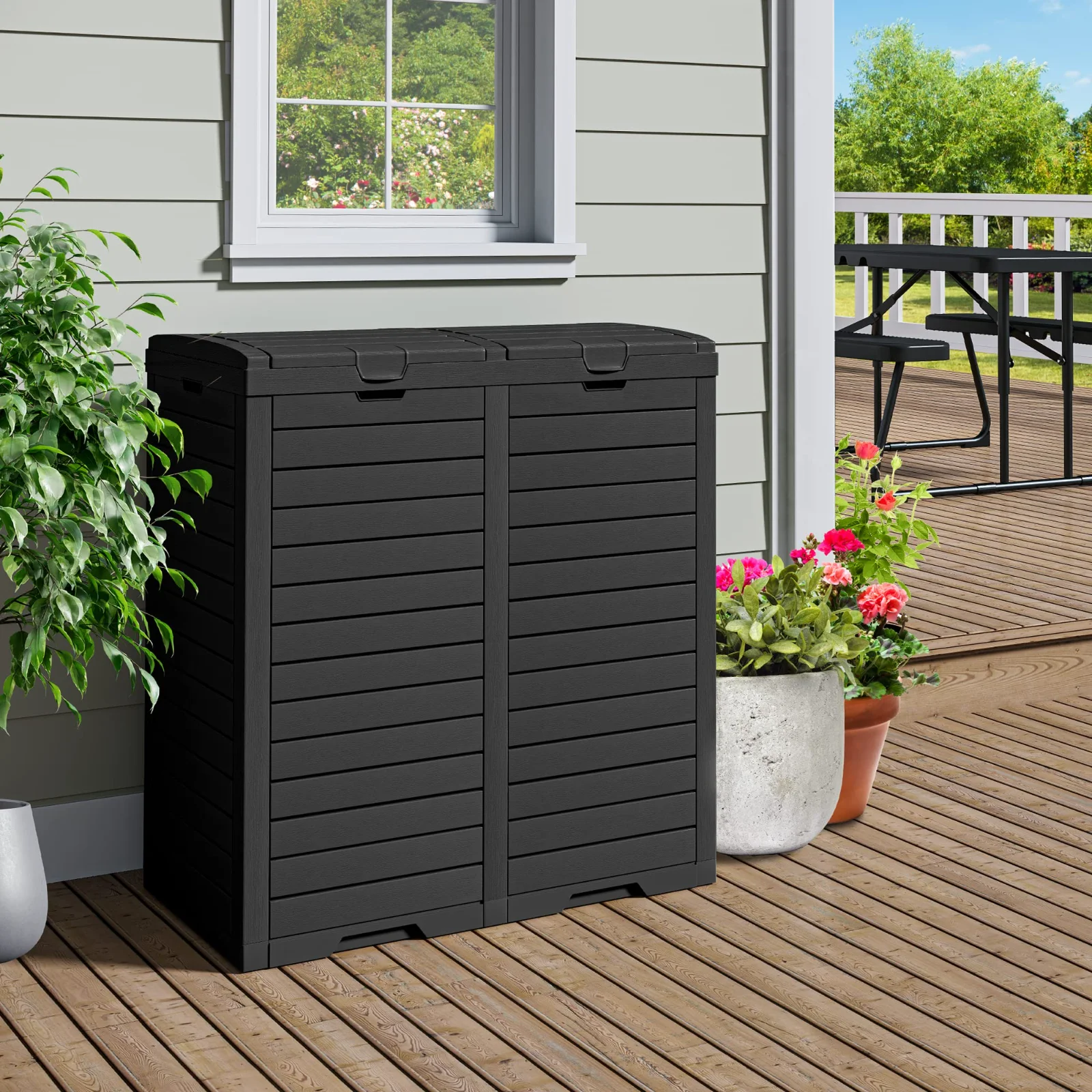
| Full deck box | 120 to 180 gallons | A full seating set of cushions plus the umbrella and the games |
| Driveway chest | 230 to 320 gallons | Cushions for a large set, folding chairs, and the overflow that used to win the garage |
| Small shed | 3 by 5 to 4 by 6 feet | Mower, trimmer, fuel can, soil bags, wall tools |
| Mid shed | 6 by 4 to 8 by 6 feet | Everything above plus bikes and the wheelbarrow |
| Large shed | 9 by 4 feet and up | The full lawn fleet with room to walk in and turn around |
Two warnings about reading size labels anywhere, including on our own cards. First, gallons describe the container, not the opening. A box with a narrow mouth can technically hold an umbrella that will never physically enter it. Check the lid opening against the longest rigid thing on your audit list. Second, shed footprints describe the outside. Walls and framing take their share, and the usable floor is smaller than the label. This is true of every maker's sheds, ours included, and it is another quiet argument for the next size up.
“I’m using this cabinet outside for pool supplies and towels, and it’s been really helpful for keeping everything organized. It fits nicely in a smaller space but still holds quite a bit.” A five-star field report on our 5x3 resin shed, word for word.
Deck box or shed? The rule of wet and dry trips
The most common sizing question we get is really a placement question: one big shed, or a shed plus boxes? The answer hides in your weather behavior. Count the trips you make when rain starts: cushions in, games in, towels in. Everything in that scramble belongs in a deck box at the scramble's location, because a storage solution thirty feet away from the rain is not a solution, it is a jog. Everything else, the things you fetch on purpose in dry weather, can live at the fence line in a shed.
This split is why our deck box range runs from door-side to driveway scale rather than clustering at one size. The box is doing a different job at each station of the deck. A pair of small boxes at the two doors often beats one large box in the middle, for the same reason two wastebaskets beat one: the distance to the address is the whole battle.
There is one thing a deck box should not be asked to do, and that is store anything that must never freeze or cook. A sealed resin box in July sun is an oven, and in January it tracks the outside air. Paint, propane, electronics and anything pressurized belong elsewhere, with the propane outdoors and shaded per its own labeling, never in a sealed box.
Resin or steel: an honest comparison
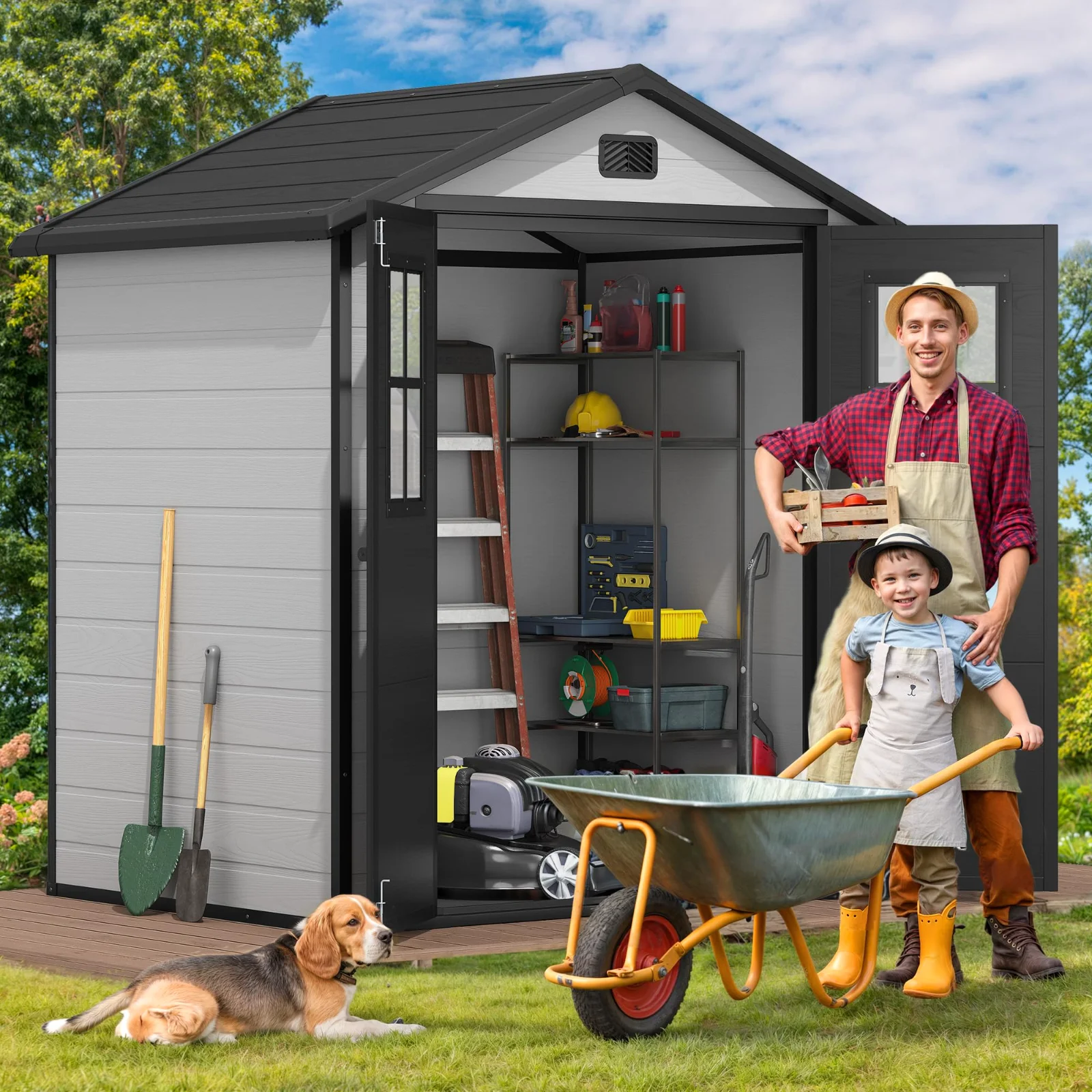
We build sheds in both materials, so we have no horse in this race, and each one wins on different lots. Resin is moulded, double-walled where lids or benches need strength, and completely indifferent to water. It never rusts, never needs paint, and a hose restores it to showroom in five minutes. Its trade is stiffness: resin panels want a level base and a full anchor set, and a resin shed is the wrong wall to lean a heavy rack against.
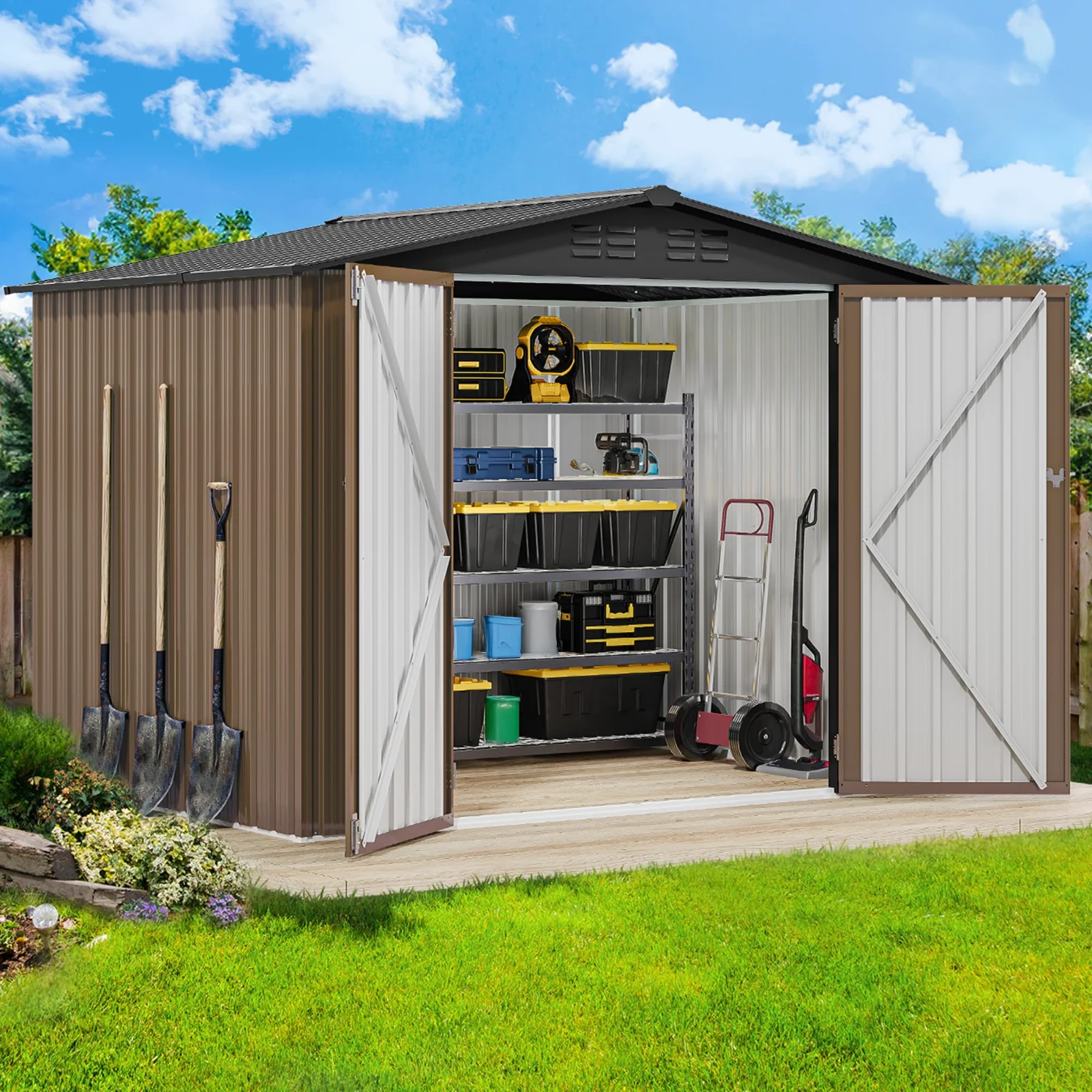
Steel buys structure. A galvanized or powder-coated steel shed carries snow load and door slams that resin will not, holds a wall of hanging tools, and generally survives the impact of a teenager's bicycle at speed. Its trade is the coating: steel is only as good as what covers it, so our steel is treated before assembly and no bare edge hides inside a seam. If you cut a steel panel during a modification, seal the cut, because that edge is now your responsibility.
The decision usually reduces to three questions. Heavy snow: steel, or a resin model with a rated roof and the snow knocked off. Salt air or constant sprinkler spray: resin. A wall of hanging tools and a workbench inside: steel. On a mild lot with a level base, either serves, and the choice comes down to the look you want at the fence.
The base is half the shed
No purchase decision matters more than the ground the shed stands on, and no corner gets cut more often. A shed on bare lawn sinks unevenly within a season. The doors rack out of square, the roof panels stress, and a structure that was plumb in June sticks by October. Every assembly complaint we have ever traced to a warped door started with a base that was not flat.
The good news is that a proper base is a weekend, not a contract. Pavers on a tamped gravel bed work for small and mid sheds. A poured slab is the gold standard for large ones. A pressure-treated timber frame filled with gravel splits the difference. Whatever the method, the test is the same: a straightedge across the surface should rock nowhere, and water should drain away from the footprint, not into it. Build the base a few inches larger than the shed on every side, and life gets easier at anchor time.
While the gravel is out, think about the approach. A stepping-stone path from the shed door toward the lawn keeps the doorway from becoming a mud pit, and a threshold ramp turns the door sill from a lift into a roll for the mower and the wheelbarrow. The audit told you what rolls, and the base plan should honor it.
Anchoring: the step that separates a structure from a kite
Wind does not negotiate. An unanchored shed is a box kite with delusions, and an unanchored deck box lid is a sail. Every structure we sell has anchor points framed in, and the instructions in each box specify the pattern for its own panels, and those instructions outrank anything on this page. The general logic, though, is worth understanding, because it is the same logic that governs tall furniture indoors.
A structure fails at its connection to the ground first. Anchors into a slab are strongest. Auger-style earth anchors with straps serve on gravel and soil bases. The time to install them is during assembly, while the floor is empty and the hardware is in your hand, not after the first forecast with a number in it. The pattern matters more than the torque: anchors on one side of a shed accomplish very little.
The indoor half of storage obeys the same physics at smaller scale. Pantry cabinets, entryway hall trees and any storage furniture with doors, drawers or shelves should be strapped to the wall with the anchor kit that ships in the box. The Consumer Product Safety Commission has run an entire campaign, Anchor It!, on exactly this, and a federal stability rule for clothing storage furniture has been in force since September 2023. It takes one stud, one bracket and fifteen minutes, and it converts a tipping hazard into a wall feature. We pack the kit, and the wall is your side of the deal.
“It large, holds all kinds of junk, and can be used as a bench as well.” A five-star field report on the louvered deck box, word for word, typo and all.
Loading a shed so the shed stays loaded
A shed fails as an organizational system long before it fails as a building, usually in the first month, usually because everything went in on the floor. Floor space is the most expensive real estate in the building. Spend it only on things with wheels or weight. The mower, the wheelbarrow and the soil bags live at floor level, wheels toward the door, because you take them out forward and put them back forward.
Everything else goes up. Wall hooks carry the long-handled fleet, rakes and shovels and the trimmer, handle down, head up, so the working end is visible and the floor stays sweepable. Shelves carry the small heavy things, fuel and fertilizer and hand tools, at waist height where lifting is safe. The ceiling, in a walk-in shed, carries the seasonal strangers: the roof rack, the sled, the folding tables that surface twice a year.
A shed is organized when the most-used thing is the fewest motions away, and you can find anything by flashlight.
Leave one shelf empty on loading day. Not as philosophy, as engineering: the empty shelf is where next season's acquisition goes, and without it the floor starts collecting again by August. The deck boxes obey a version of the same rule: cushions go in dry, stacked in the order they come out, and the box that requires archaeology every evening stops being used by July.
The seasonal rhythm
Storage is not static. It breathes twice a year, and the structures are built around that rhythm. The spring turnover moves the cold fleet back, snow tools to the deep wall, mower forward, cushions out of the boxes and onto the frames. It is also inspection day: check anchor tension after the ground's freeze-thaw cycles, sweep the shed floor, open the deck box lids and let them air an hour before the season's first load.
The fall turnover reverses the flow, and it is where deck boxes earn their price. Cushions go in clean and bone dry, because a sealed box preserves whatever state its contents arrived in, mildew included. The mower goes to the back wall, fuel stabilized or drained per its own manual. Hoses drain and coil. And the driveway-scale chest swallows the folding chairs and the summer overflow that would otherwise re-colonize the garage over winter.
If your fall turnover includes the cookout gear, the cooler chapter of this series, the cookout cold chain guide, covers how the rolling chests store between seasons, and the shade guide covers what winter means for canopies and gazebo curtains. The three systems come indoors, or into the shed, in the same weekend.
Maintenance, measured in minutes
The maintenance schedule for a well-built storage stack is honestly short, which is rather the point of buying one. Resin wants a hose and a soft brush once or twice a season, and its hinges want nothing. Steel wants its coating watched: a scratch that reaches metal gets cleaned and touched up before winter, and door tracks get a dry lubricant once a year. Both kinds want their roofs kept clear: snow raked off after heavy falls, branches off after storms, because load ratings describe snow, not snow plus a limb.
Locks and hinges everywhere prefer dry lube to oil, because oil holds grit. Anchor straps get a glance every spring. Deck box gaskets get wiped when the lid is open anyway. That is the whole program: perhaps an hour a year, spent mostly in two seasonal turnovers you were doing regardless. Structures that demand more than that were built wrong, and the field reports would have told us by now.
What this all buys back
The point of the storage plan was never the structures. It is the building they empty. A garage that stores vehicles again, a deck where the evening starts without a scramble, a garden where the tools are one motion from the soil. Price the whole stack against the cost of one more year of the crowded version, the re-bought duplicates of tools that were merely lost, the cushions replaced after one uncovered winter, and the plan generally pays for itself before the second season.
Start with the audit. Buy the next size up. Build the base flat, anchor everything with a roofline or a drawer, load the floor last, and leave one shelf empty. Every card on the front page lists its gallons or its footprint in plain type, every figure comes from our last update, and the how we update page says exactly when that was. The rest is a free weekend and a notepad.
